

Choosing Driving Pulley: Application Fit and Specification Checks
THE BUYER'S GUIDE / SELECTION
Choosing Driving Pulley: Application Fit and Specification Checks
A well-chosen Driving Pulley keeps a belt conveyor running reliably under its intended load. This guide explains what a driving pulley does, the key structural and duty-class differences that affect selection, the surface-treatment options that govern belt grip, and the material and shaft specifications buyers should verify before placing an order. References are drawn from confirmed product specifications published by Yanshan Aohua Machinery Equipment Manufacture Limited Company.

Duty class (Light / Medium / Heavy) determined by calculated conveying capacity, required torque, and resultant belt force — not by belt width alone.
Surface treatment of the drum face (herringbone rubber, diamond-shape rubber, or ceramic rubber) matched to friction requirement, operating environment, and acceptable belt wear rate.
What a Driving Pulley Does
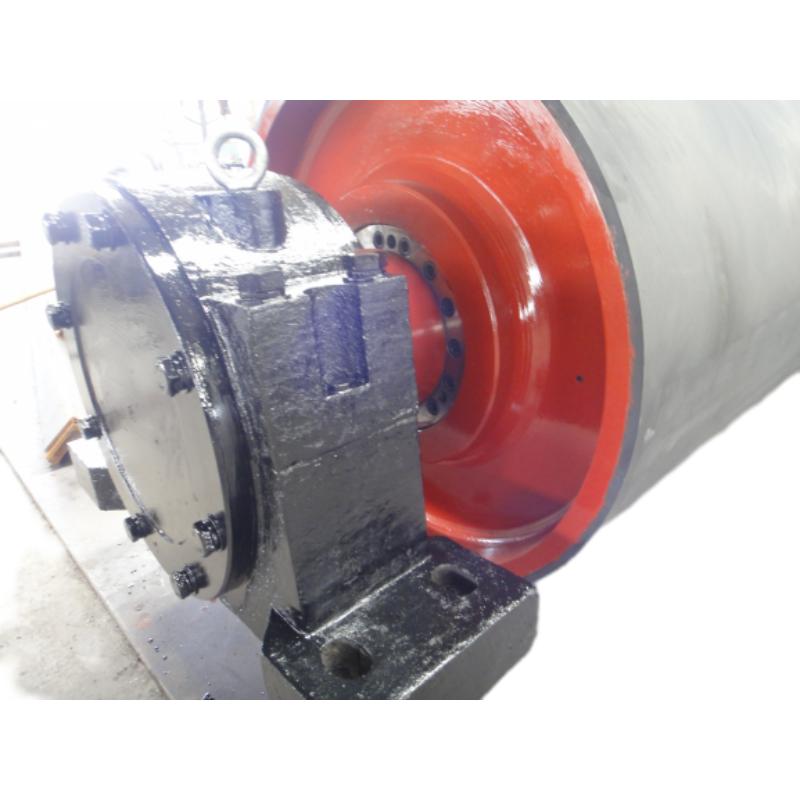
A Driving Pulley is the power-transmission component at the head of a belt conveyor. Its role is to transfer the kinetic energy of the drive motor to the conveyor belt and keep it moving in a continuous loop. Because the pulley must transmit torque while resisting the resultant forces generated by the loaded belt, the correct selection depends on a clear calculation of conveying capacity, torque demand, and resultant belt tension for each specific installation.
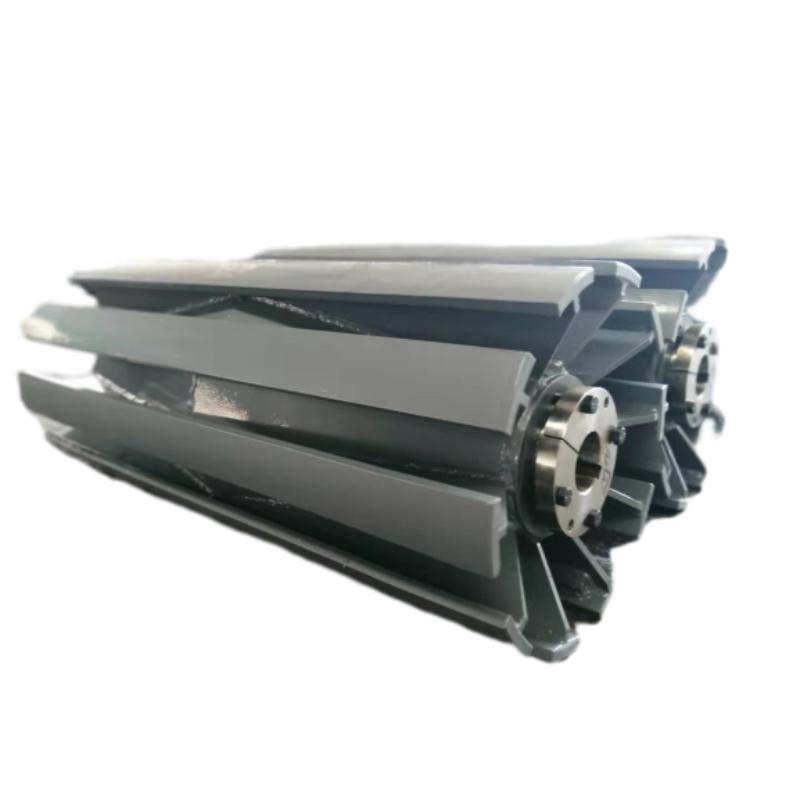
Driving pulleys are not interchangeable with non-driving (bend) pulleys. A bend pulley redirects the belt path or increases the belt's wrap angle; it carries no drive torque. Confusing the two roles leads to undersized or oversized shaft and hub connections, mismatched bearing bores, and potential early failure.
Duty-Class Framework: Light, Medium, and Heavy
Yanshan Aohua Machinery Equipment Manufacture Limited Company's driving pulleys are grouped into three duty classes, each with distinct structural characteristics:
| Duty Class | Drum Body Construction | Shaft-to-Hub Connection |
|---|---|---|
| Light-duty | Welded steel plate | Single key |
| Medium-duty | Welded steel plate | Expansion sleeve |
| Heavy-duty | Welded cast iron plate | Expansion sleeve |
Why it matters for selection:
- Light-duty units suit lower conveying capacities with moderate torque loads. The single-key connection is straightforward to assemble and replace.
- Medium-duty units step up to an expansion-sleeve connection, which distributes clamping force evenly around the shaft and is better suited to variable or reversing loads.
- Heavy-duty units add a cast iron drum body for greater rigidity under high resultant belt forces, while retaining the expansion sleeve for reliable power transmission. Both one-side-out and both-sides-out shaft configurations are available at the heavy-duty level.
Buyers should determine their required torque and resultant force through engineering calculation before selecting a duty class — not after.
Drum Body and Shaft Materials
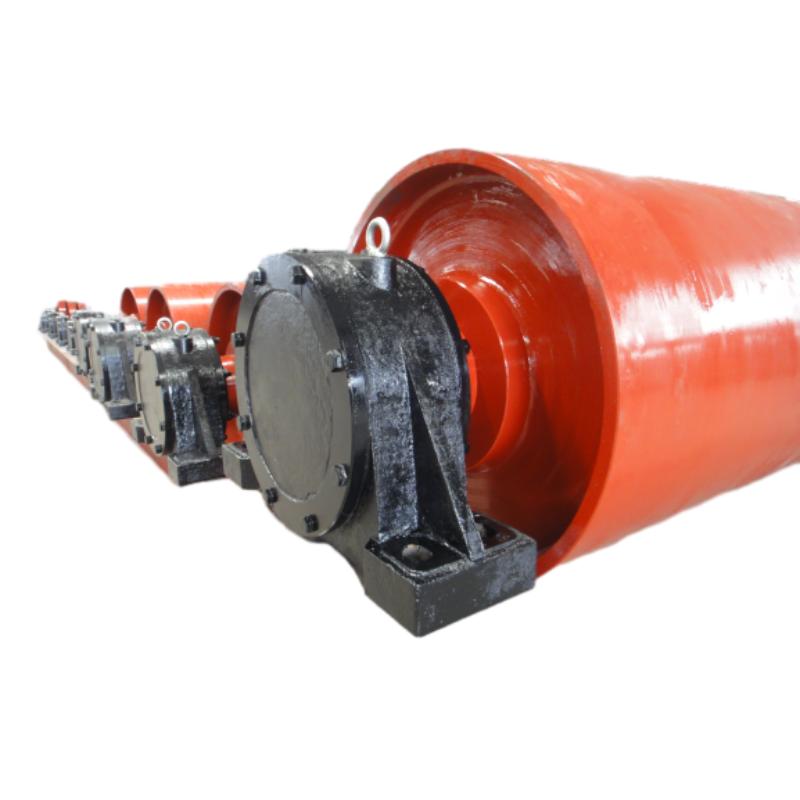
The drum body is manufactured from carbon steel (Q235 or Q355). Outer diameters range from 219 mm to 2,000 mm; face lengths run from 500 mm to 6,000 mm. The shaft material is either #45 steel or 42CrMo alloy steel, the latter providing higher tensile strength for demanding applications.
Weld quality is a structural safety factor. The product uses gas shielded welding and submerged arc welding. Circumferential and longitudinal weld seams on the drum body, as well as cast parts, are subjected to ultrasonic inspection in accordance with specified requirements. This inspection step is relevant to buyers in industries with mandatory structural integrity standards — such as mining, port, and steel-plant applications.
Bearing and Expansion-Sleeve Selection
Bearings fitted are double-row aligning cylindrical bearings, available in brands including HRB, ZWZ, LYC, NSK, NTN, TIMKEN, FAG, and SKF. Where a specific bearing brand is required by the end-user's maintenance inventory or plant standard, this should be confirmed as a line-item in the purchase specification.
Expansion sleeves are sourced from brands including Z9, RINGFEDER, RINGSPANN, BIKON, and FENNER. The expansion-sleeve brand affects the available torque capacity and dimensional compatibility with the shaft. Buyers using RINGFEDER or RINGSPANN should verify that the hub bore and shaft tolerance match the specific sleeve series selected.
Surface Treatment: Matching Belt Grip to the Application
The surface of a driving pulley determines friction between pulley and belt. An inadequate friction coefficient causes belt slip; an abrasive surface can accelerate belt wear. Three rubber-facing options are:
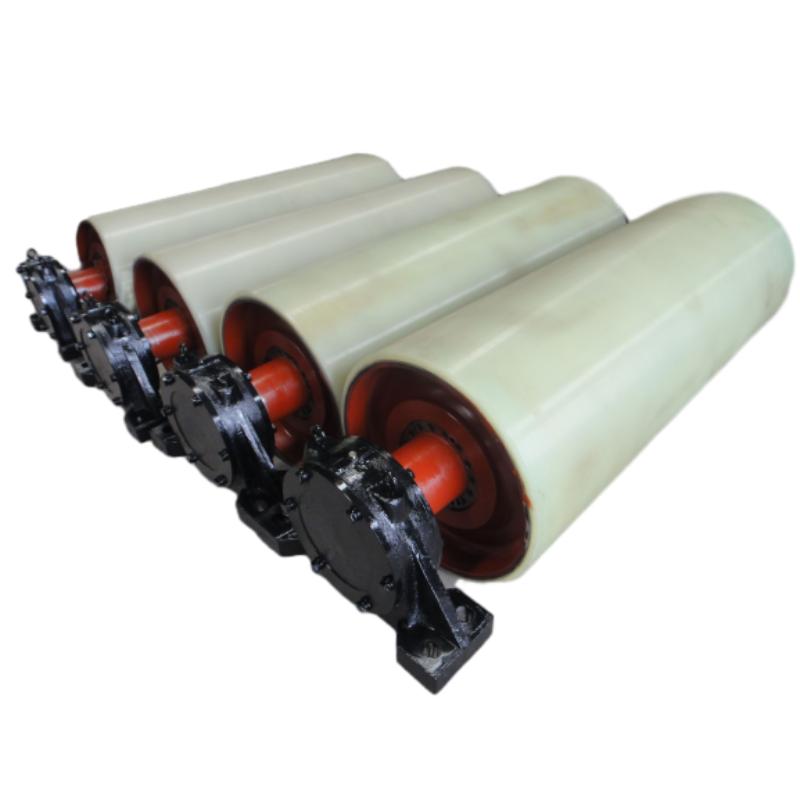
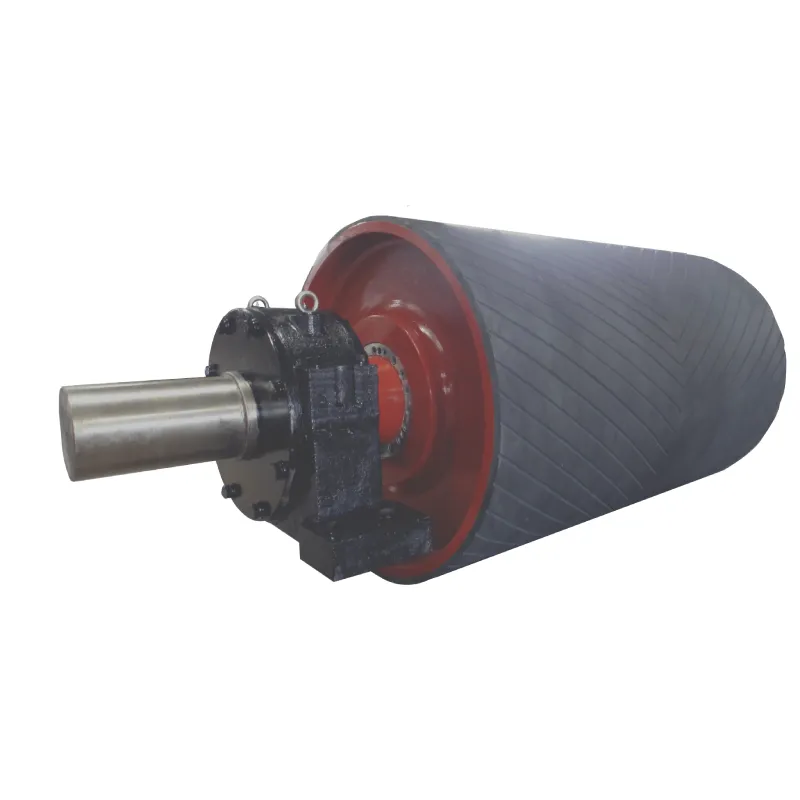
- Herringbone rubber — the angled groove pattern provides directional traction and assists in shedding water or loose material from the contact surface.
- Diamond-shape rubber — the cross-hatched pattern distributes grip more evenly across the belt width, suited to wide belts with varying load distributions.
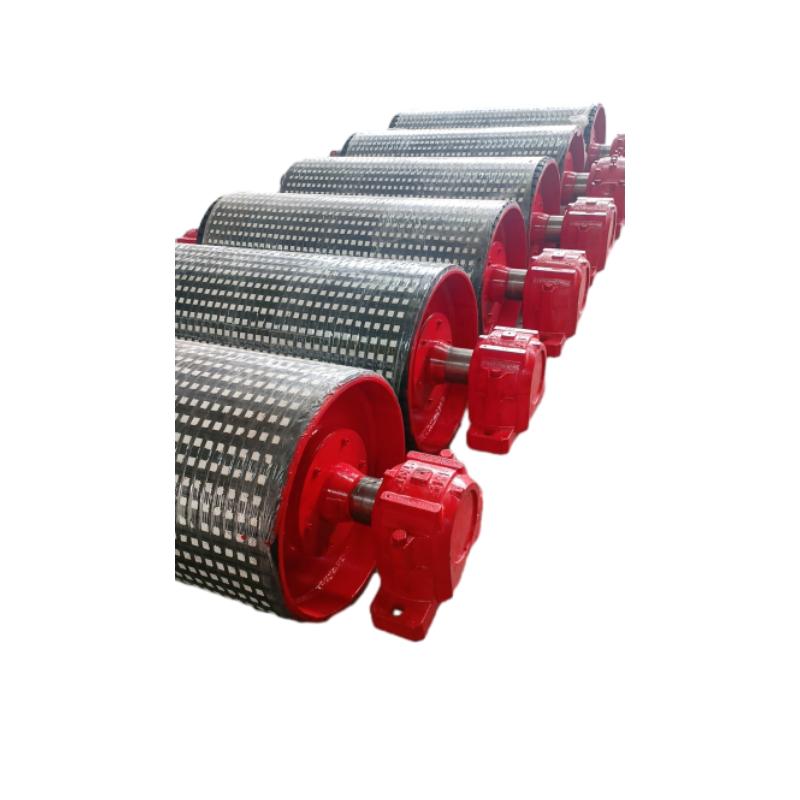
- Ceramic rubber — the ceramic inserts embedded in rubber deliver the highest friction values and are chosen where heavy-duty or wet-environment conditions require maximum grip without excessive belt wear.
In dry, lightly loaded applications a plain steel surface may suffice; confirming the slip risk and maintenance preference with the end-user before specifying a facing will prevent unnecessary cost or premature belt wear.
Industry Applications and Standards
The driving pulley is designed for use across power generation, metallurgy, mining, coal, cement, steel, chemicals, seaport, hydropower, and grain industries. This broad application range means that the applicable industry standard — GB, ISO, DIN, CEMA, or JIS — will typically vary by customer geography and sector. Buyers in the United States and Canada often specify CEMA; European projects commonly require ISO or DIN; buyers in Southeast Asia or the Middle East should confirm which standard is mandated by the end-user or regulatory body.
Balance grade is G40, applied during manufacture to minimise vibration at operating speeds.
Documented service life exceeds 30,000 hours under specified operating conditions. Buyers should relate this figure to their annual operating hours and maintenance interval targets when evaluating total cost.
Structural Design and Computer-Aided Parameter Determination
Axle diameter, drum-body wall thickness, end-disc thickness, and the position of circumferential weld seams are determined using a specialised computer program. The stated design objective is minimum stress and minimum fatigue cycles at the weld joints. This parametric approach is relevant to procurement teams that require documented design methodology as part of project approval — the supplier can be asked to supply the design calculation output or a drawing with key parameters annotated.
Selection Checklist for Buyers
Before finalising a driving pulley specification, confirm the following:
- Conveying capacity and belt tension — determines the required torque and resultant force, which in turn sets the duty class.
- Belt width and speed — governs the required face length and OD range.
- Shaft-out configuration — one-side-out or both-sides-out, relevant primarily to heavy-duty units.
- Shaft material — #45 or 42CrMo, based on torque and fatigue requirements.
- Surface treatment — herringbone, diamond, or ceramic rubber facing, matched to grip requirement and environment.
- Bearing brand preference — for compatibility with the plant's maintenance stock.
- Expansion sleeve brand and series — to ensure correct torque capacity and dimensional fit.
- Applicable standard — GB, ISO, DIN, CEMA, or JIS, as required by the project specification.
- Welding and inspection requirements — confirm whether ultrasonic weld inspection records are required for project documentation.
Price, lead time, and export-market availability should be confirmed directly with Yanshan Aohua Machinery Equipment Manufacture Limited Company, as these are not fixed in published product specifications.
THE PEOPLE

About the author
THE COMPANY
Yanshan Aohua Machinery Equipment Manufacture Limited Company
Yanshan Aohua Machinery Equipment Manufacture Limited Company. is located in the east outer ring of Yanshan County, CangZhou city,Hebei Province, China.Which is 150 kilometers away from Tianjin XingGang Port,China.and 60 kilometers away from Huanghua Port, China with super convenient transportation. our company was established in March 2007, which is a specialized enterprise in belt conveyor and parts&components research ,development, manufacturing and sales . Mr.…
About Us ↗Visit company website ↗YOUR NEXT STEP
Bring your brief. Start a useful conversation.
Use case, specification, quantity and delivery window: make the next conversation specific.
-
How to Choose a Self Aligning Idler for Belt TrackingNewsNov.10,2026
-
Rubber Lagging Pulley Questions on Materials, Fit and Test DataNewsNov.02,2026
-
Self Aligning Idler FAQ: Specifications, How It Works, Ordering & SupportNewsOct.28,2026
-
Choosing an Idler Frame: Application Fit and Specification ChecksNewsOct.27,2026
-
Choosing AH Labyrinth Seal: Medium, Dimensions and Operating ConditionsNewsOct.27,2026
-
Friction Head of Roller FAQ: Specifications, Ordering and Support QuestionsNewsOct.27,2026